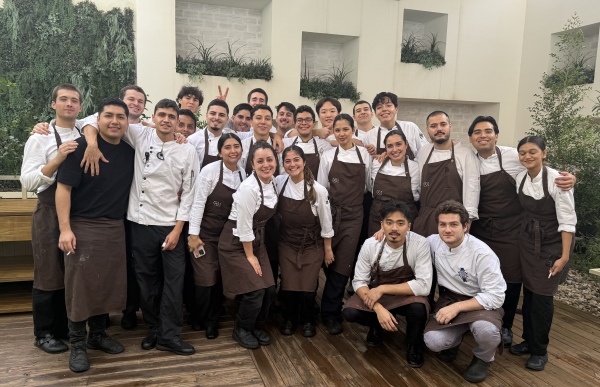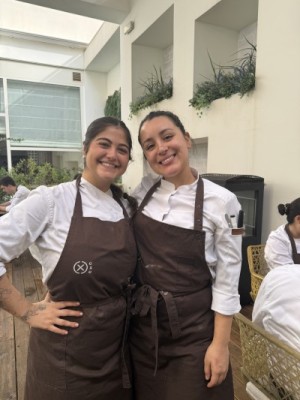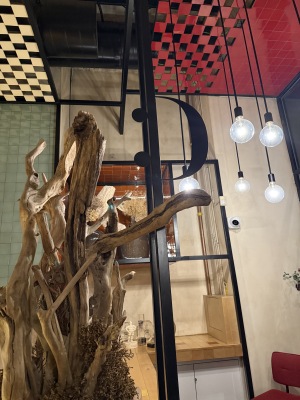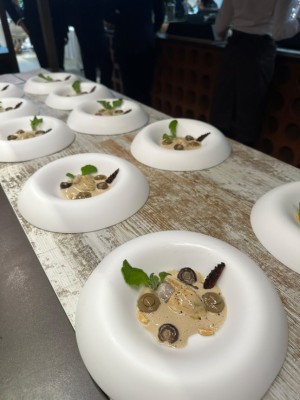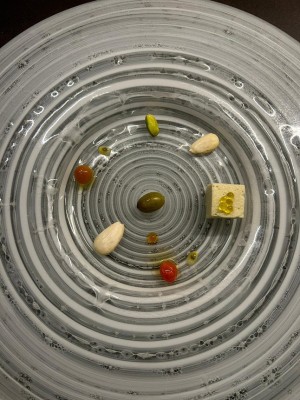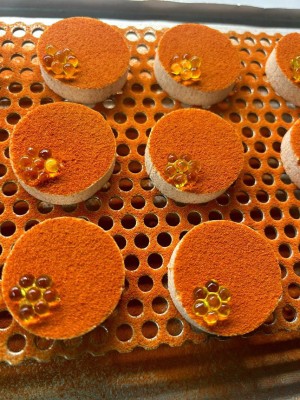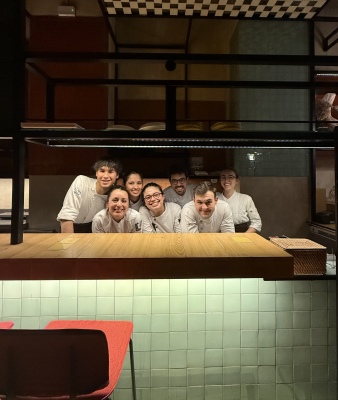


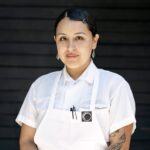
As a recipient of the Ment’or Grant, I had the privilege of being part of Disfrutar’s kitchen team for two months. Disfrutar is located in the Eixample neighborhood of Barcelona which is home to some of the best restaurants in the city. Its central location made my time in Spain idyllic and allowed me to be fully immersed in the city and its culture. One of Barcelona’s iconic markets, the Mercat del Ninot, was across the street from the restaurant, which made walking to and from work even more enjoyable. I was able to immerse myself in local products and produce, which was one of my goals for this stage.
Being from California, I’m used to a more simplistic style of cooking - making delicious food with fresh ingredients, with little to no manipulation. We allow the ingredients to speak for themselves. During my stage, I wanted to experience and understand cooking on the opposite end of the spectrum – to manipulate and create unbelievable textures and shapes out of ingredients. What better place to learn about these techniques than Disfrutar, the 2024 Best Restaurant in the World!
At Disfrutar, I experienced the restaurant from many angles. Every three weeks, I worked in a different part of the restaurant, learning new things at a fast pace. My first three weeks were spent in preparación frío, the cold-preparation team. With the guidance of Chef de Partie Cott, I did all the foundational prep, which varied from day to day. We did light butchery work with squabs, cut spaghetti-shaped strings out of kombu, and stood in front of a microwave for hours making delicate mushroom-flavored leaves, among many other tasks. Aside from learning how to do these tasks well and as efficiently as possible, I learned how demanding it is to be a Chef de Partie at the restaurant. Each Chef de Partie trains new people on a weekly basis, carries all the responsibility for what the station produces, and wears an earpiece connected to a walkie-talkie through which they must listen to constant communication among the managers and other chefs. I have never seen this level of organization. Under this system, whenever something needed to be addressed, it was addressed immediately.
After my first three weeks, I moved to cuarto frío, a station located in the open kitchen upstairs. This was, in my opinion, the hardest part of my experience. Once you start working on the line, you are placed under a microscope. Every move you make can either improve or ruin your timing during prep or service. Every move matters. You were expected to outperform everyone—including yourself—every day. One of my managers told me, “I expect you to do the impossible in hopes of making it possible.” As much as I love that sentiment, it made the job very challenging. As challenging as it was, however, it helped me grow mentally. It reassured me that I can stay calm in those situations and push through moments that feel impossible.
I had around three hours to prep for both services offered each day. Each service was fully booked with 50 guests. We were also responsible for keeping our station clean and organized. We had to keep inventory of our mise en place and were given increasing levels of responsibility. By the end of my third week in cuarto frío, I finally felt like I understood the station, the interpersonal relationships with the chefs, and—most importantly—how the restaurant operates.
My last few weeks at Disfrutar felt like a dream. I was finally placed at the station I had always hoped to see: pastry. The pastry station is located at the front of the restaurant and has a bar where guests can dine. The workload was different, the tasks were more intriguing, and the Chefs de Partie trusted me much more. I was able to assist with some ice cream prep, became very comfortable working with liquid nitrogen, and used my quenelling skills to work with and polish many molds for their chocolate creations. One of the coolest techniques I saw in pastry involved using nixtamalization to create a warm disc of praline with a gooey chocolate center. At Californios, nixtamalization is no foreign technique—calcium hydroxide is at the core of Mexican cuisine. It’s what gives us tortillas! But using calcium hydroxide in this new way was eye-opening and I am very excited to incorporate it with California produce.
Gastronomy, in my opinion, is such a playful way of working with ingredients. It is all about imagination and achieving what is believed to be impossible. I am excited to show my team how to use liquid nitrogen, how to work on their efficiency and to bring the soul of California cuisine to gastronomy.